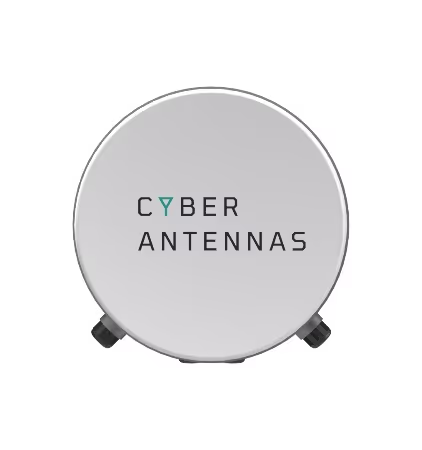
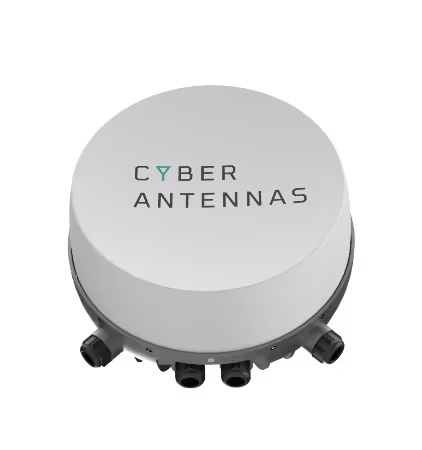
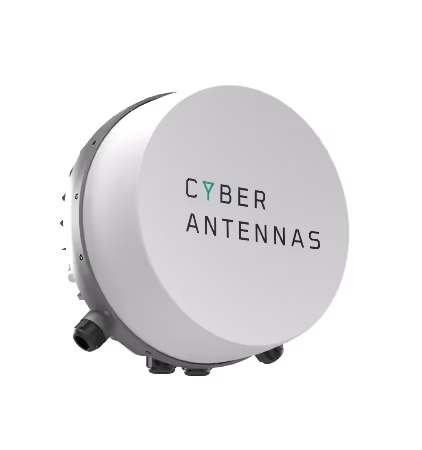
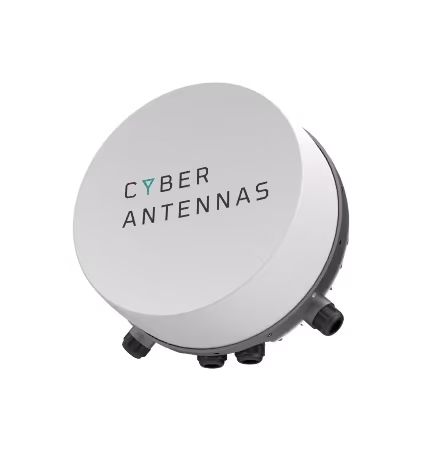
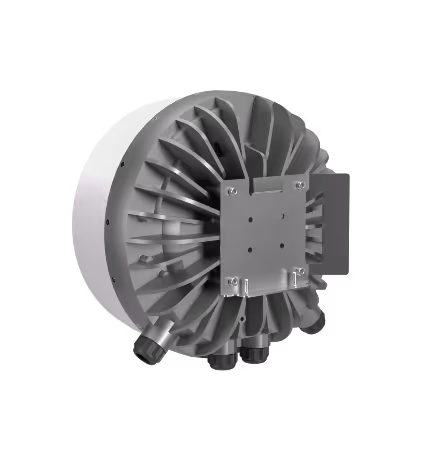
Overview
Cyber Antennas' T1 Sector is a high-capacity, tri-band Wi-Fi 7 access point with integrated 4x4 sector antennas, designed to help network operators scale efficiently. With Cyber Antennas' unique fixed wireless platform, the T1 Sector automatically forms a self-organizing network (SON), intelligently alternating between the 6 GHz low and high bands to optimize performance.
Massively ScalableThe T1 Sector is Cyber Antennas' first tier in a three-tier automatic star topology, using alternating 6 GHz bands, Wi-Fi 7 technology, and advanced antennas to scale unlicensed fixed wireless networks with optimal efficiency and capacity.
Alternating Wireless Backhaul Channels
By alternating between 6 GHz high and low channels and automatically organizing into a star topology, Cyber Antennas self-organizing networks (SONs) are able to scale beyond traditional mesh networks.
Advanced Digital Beamforming (DBF)
Cyber Antennas uses Qualcomm's advanced digital beamforming technology, dynamically steering signals to devices, optimizing link stability, enhancing signal clarity, and significantly improving coverage and performance in challenging RF environments.
Optimized Airtime Efficiency
By using short-range omni-directional antennas, Cyber Antennas mesh doesn't require a proprietary Time Division Multiple Access (TDMA) scheduling protocol. Instead, all Cyber Antennas mesh Wi-Fi products include advanced Wi-Fi 7 features such as Orthogonal Frequency Division Multiple Access (OFDMA, enhancing simultaneous connections) and Multi-user Multiple Input Multiple Output (MU-MIMO, improving multiple-device communication) ensure optimal airtime efficiency.
Multi-gigabit SpeedsCyber Antennas T1 Sector delivers faster speeds than Ubiquiti AirMAX, LTU, Cambium ePMP 4500 & ePMP 4600, Tarana G1/G2 by utilizing Wi-Fi 7 innovations to maximize speed, throughput, and efficiency.
320 MHz Channels in 6 GHz
Provides significantly higher bandwidth compared to narrower channel widths used by older PtMP unlicensed technologies like Ubiquiti AirMAX & LTU, Cambium ePMP, and Tarana G1.
12 data streams
The T1 Sector delivers industry leading speeds by using three frequency bands (5/6L/6H) with four spatial streams per band for unrivaled parallel data flow.
Simple to Install and ManageCyber Antennas is easier to install than Ubiquiti AirMAX, LTU, Wave, Cambium ePMP 4500 & 4600 and Tarana because the stations automatically and securely connect to the access points, and cloud adoption is simple using QR codes.
Plug-and-Play Deployment
Automatic AP detection, QR code cloud adoption, and a preferred access point lists make setup fast and seamless.
3-Tier Self-organizing Network (SON)
Cyber Antennas’ 3-tier self-organizing network simplifies deployment by eliminating manual setup, automatically configuring itself, optimizing routes, and self-healing to ensure reliable coverage in the toughest environments.
Adapts to Changes in the Environment
Cyber Antennas' carrier-grade IP67-rated equipment combines a self-organizing network (SON), advanced antenna design, and digital beamforming (DBF) to enhance signal quality and adapt to environmental changes like foliage or shifting conditions. This reduces maintenance demands and lowers total cost of ownership.
Designed to Solve Common Wireless Network ChallengesLimited Network Capacity
Traditional wireless access points can struggle to support large numbers of users and bandwidth-intensive applications. The T1 Sector's tri-band Wi-Fi 7 architecture, 12 data streams, and support for advanced technologies such as OFDMA and MU-MIMO significantly increase network capacity, allowing operators to serve more subscribers simultaneously.
Network Congestion and Spectrum Limitations
As wireless networks grow, congestion in traditional frequency bands can reduce performance. The T1 Sector's operation across 5 GHz, 6 GHz Low, and 6 GHz High bands provides additional spectrum resources, helping operators distribute traffic more efficiently and reduce congestion.
Difficulty Delivering Multi-Gigabit Speeds
Many legacy wireless platforms cannot consistently provide multi-gigabit performance. The T1 Sector supports Wi-Fi 7 technologies including 320 MHz channels and 4K-QAM, enabling operators to deliver higher throughput and offer premium broadband services.
Complex Network Deployment and Configuration
Deploying large wireless networks often requires extensive manual configuration and ongoing optimization. The T1 Sector's self-organizing networking capabilities, automatic access point detection, and cloud-based provisioning simplify deployment and reduce operational complexity.
Poor Scalability as Subscriber Counts Grow
As more customers are added to a network, operators often face the need for costly upgrades or complete redesigns. The T1 Sector is designed to scale efficiently, allowing providers to expand coverage and subscriber capacity while maintaining high performance.
High Infrastructure Costs
Building fiber networks or deploying multiple standalone devices can be expensive and time-consuming. The T1 Sector combines tri-band Wi-Fi 7 technology and integrated 4x4 90° sector antennas into a single platform, helping reduce equipment requirements and simplify installations.
Future Technology Upgrades
Many wireless platforms become obsolete as new standards and bandwidth requirements emerge. The T1 Sector's Wi-Fi 7 architecture and tri-band operation provide a future-ready platform designed to support growing bandwidth demands and next-generation wireless applications.
Typical Use CasesHigh-Capacity Point-to-Multipoint (PtMP) Broadband Networks
The T1 Sector is designed as a tri-band Wi-Fi 7 access point with integrated 4x4 90° sector antennas, making it ideal for serving multiple subscribers from a single tower or rooftop. Its multi-gigabit capacity and 12 data streams allow WISPs to deliver high-speed internet to many customers simultaneously.
Rural and Underserved Broadband Deployments
WISPs can use the T1 Sector to provide broadband connectivity in rural, remote, and hard-to-wire locations where fiber deployment is impractical or too expensive. Its high capacity and automated network capabilities help operators efficiently expand coverage areas.
High-Density Subscriber Environments
With Wi-Fi 7 technologies such as OFDMA, MU-MIMO, 320 MHz channels, and 4K-QAM, the T1 Sector is well suited for areas with a large number of active users, including residential neighborhoods, apartment complexes, business parks, and campuses. These technologies improve network efficiency and allow more devices to communicate simultaneously.
Self-Organizing Wireless Networks (SON)
The T1 Sector serves as the first tier of Cyber Antennas' three-tier self-organizing network architecture. It automatically forms and optimizes network connections, reducing manual configuration and simplifying large-scale network deployments. This makes it ideal for operators building scalable wireless infrastructure.
Multi-Gigabit Premium Service Offerings
The T1 Sector's tri-band operation (5 GHz, 6 GHz Low, and 6 GHz High) and support for 320 MHz channels enable operators to offer premium multi-gigabit service plans that compete with fiber-like speeds while maintaining the flexibility of fixed wireless access.
Rapidly Deployable Broadband Infrastructure
The T1 Sector's plug-and-play deployment, automatic access point detection, QR-code cloud adoption, and self-organizing capabilities make it ideal for operators that need to deploy networks quickly and minimize installation complexity.
Who Is the T1 Sector Designed For?The T1 Sector is ideal for:
• Wireless Internet Service Providers (WISPs) deploying high-capacity point-to-multipoint (PtMP) networks
• Fixed wireless operators expanding broadband coverage in rural and underserved areas
• Internet service providers offering multi-gigabit residential and business internet services
• Network operators building high-density wireless networks with many simultaneously connected users
• Managed service providers (MSPs) deploying large-scale wireless infrastructure for customers
• Enterprises requiring high-performance outdoor wireless connectivity across campuses and facilities
• Hospitality operators providing broadband coverage for resorts, hotels, and large outdoor venues
• Educational institutions deploying wireless connectivity across school and university campuses
• Municipalities and smart city projects requiring scalable outdoor broadband infrastructure
• System integrators and wireless network installers designing and deploying next-generation Wi-Fi 7 networks
Frequently Asked QuestionsWhat is the T1 Sector?
The T1 Sector is a high-capacity outdoor tri-band Wi-Fi 7 access point with integrated 4x4 90° sector antennas. It is designed for point-to-multipoint (PtMP) broadband networks and large-scale outdoor wireless deployments.
Which frequency bands does the T1 Sector support?
The T1 Sector operates across three frequency bands:
• 5 GHz
• 6 GHz Low
• 6 GHz High
This tri-band architecture provides additional spectrum resources and improves network flexibility.
What type of antenna is integrated into the T1 Sector?
The T1 Sector features integrated 4x4 MIMO 90° sector antennas for each of its three radio bands, eliminating the need for separate external sector antennas.
Is the T1 Sector designed for point-to-multipoint (PtMP) networks?
Yes. The T1 Sector is specifically designed for PtMP broadband deployments where a single access point serves multiple subscriber devices across a defined coverage sector.
Does the T1 Sector support Wi-Fi 7 technologies?
Yes. The T1 Sector supports advanced Wi-Fi 7 technologies, including:
• OFDMA
• MU-MIMO
• 320 MHz channels
• 4K-QAM modulation
These technologies improve efficiency, increase capacity, and enable higher throughput.
Can the T1 Sector deliver multi-gigabit wireless services?
Yes. The T1 Sector is designed to support multi-gigabit wireless applications and premium broadband services by combining tri-band operation, multiple spatial streams, and advanced Wi-Fi 7 features.
Is the T1 Sector suitable for high-density deployments?
Yes. The T1 Sector is ideal for high-density environments because its tri-band architecture and 12 spatial streams allow it to support large numbers of simultaneously connected users.
Can the T1 Sector be deployed in rural broadband networks?
Yes. The T1 Sector is well suited for rural and underserved broadband deployments where operators need a scalable, high-capacity fixed wireless platform.
Does the T1 Sector require external sector antennas?
No. The T1 Sector integrates its sector antennas into a single outdoor unit, simplifying installation and reducing cabling and mounting requirements.
Does the T1 Sector support self-organizing networking?
Yes. The T1 Sector incorporates self-organizing network capabilities that help automate network discovery, configuration, and optimization, reducing deployment complexity.
Is the T1 Sector easy to deploy?
Yes. The T1 Sector supports plug-and-play deployment and cloud-based provisioning, allowing operators to install and manage networks more efficiently.
Who should use the T1 Sector?
The T1 Sector is ideal for:
• Wireless Internet Service Providers (WISPs)
• Fixed wireless broadband operators
• Managed service providers (MSPs)
• Enterprise and campus network operators
• Municipal and smart city network deployments
• System integrators and wireless infrastructure providers
Is the T1 Sector a future-ready platform?
Yes. The T1 Sector is built on a tri-band Wi-Fi 7 architecture designed to support growing bandwidth demands, increasing subscriber densities, and next-generation wireless applications.
Related Products
No related products found.
Related Products (Category & Subcategory)
Reviews
Loading…
T1 Sector
Model Number: T1-SECTOR
Login to add to cart
$1,999.00
High capacity tri-band (5/6L/6H) Wi-Fi 7 access point with integrated 4x4 90° sector antennas.
Features
- Wi-Fi 7 BE
- Multi-gigabit speeds
- Tri-band (5/6L/6H)
- 12 data streams
- Integrated 4x4 90° sector antenna
- 320 MHz channel widths
- 4K-QAM modulation rates
- Channel puncturing noise resistance
- IP67 weather rating
- ISPApp cloud management