microwave
About #microwave
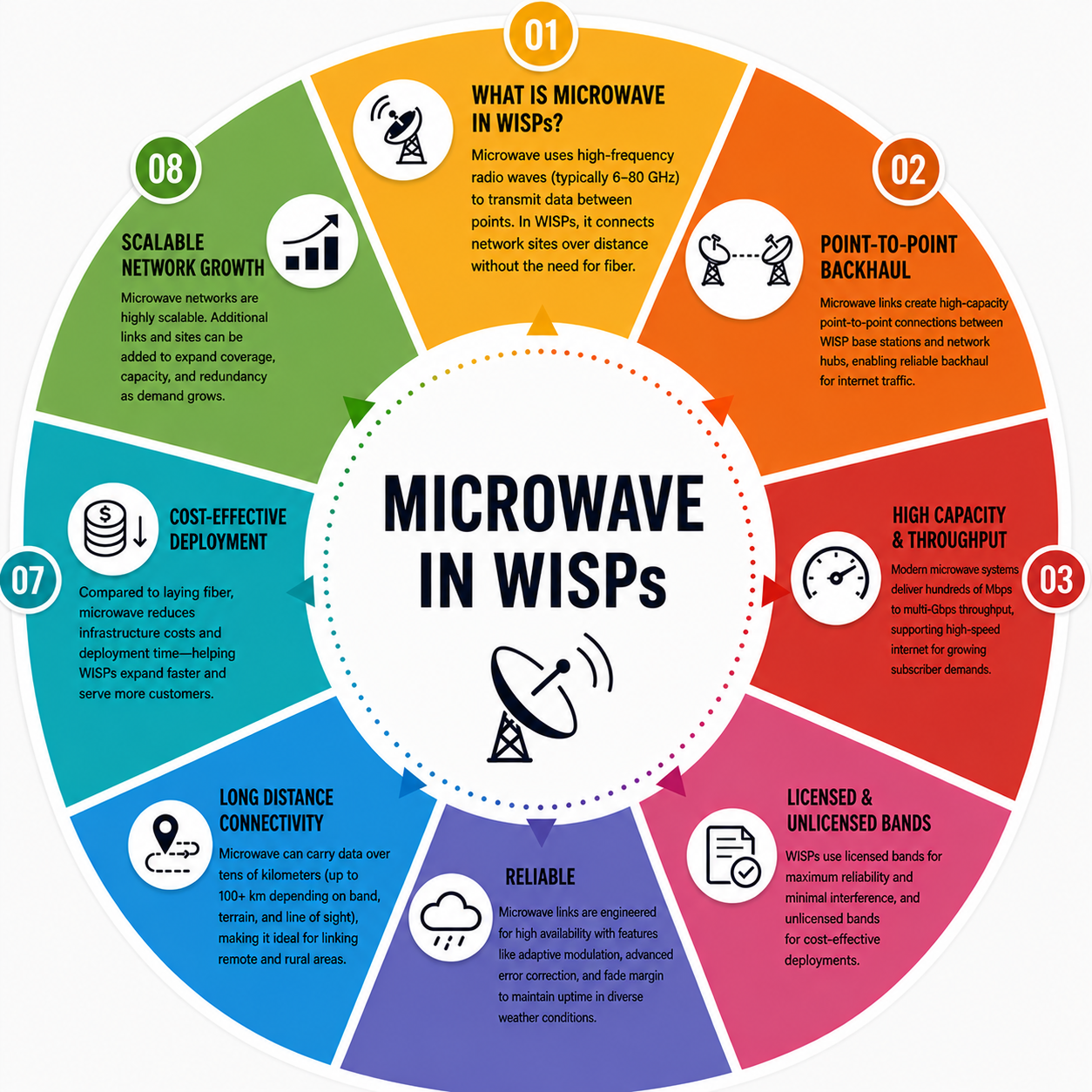
In WISP (Wireless Internet Service Provider) networks, microwave technology refers to the use of high-frequency radio waves, typically operating from around 1 GHz up to 100 GHz, to transmit data wirelessly over long distances. Microwave links are one of the most important technologies used by WISPs because they allow internet traffic to travel between towers, access points, and network sites without requiring expensive fiber infrastructure.
Microwave communication is commonly used for both Point-to-Point (PtP) backhaul links and Point-to-Multipoint (PtMP) wireless distribution systems. In a PtP setup, two microwave radios with directional antennas create a dedicated wireless connection between towers or buildings. These links are used to transport large amounts of bandwidth from one location to another, often serving as the backbone of a WISP network. In PtMP deployments, microwave-based access points distribute internet connectivity to multiple subscriber devices over a wider coverage area.
WISPs rely heavily on microwave frequencies because they support high-capacity wireless communication with low latency and stable performance. Different frequency bands are used depending on deployment requirements. Lower microwave frequencies generally provide longer range and better obstacle penetration, while higher frequencies can deliver greater throughput and capacity but usually require clearer line-of-sight conditions. Common WISP microwave bands include 5 GHz, 6 GHz, 11 GHz, 24 GHz, and 60 GHz.
Microwave systems in WISP environments use highly directional antennas such as dishes, horn antennas, or sector antennas to focus RF energy toward intended targets. This directional design improves signal strength, reduces interference, and increases spectrum efficiency. Proper alignment is extremely important because even slight antenna movement can affect signal quality and link stability.
One of the key advantages of microwave technology for WISPs is rapid deployment. Wireless microwave backhaul can often be installed much faster and at a lower cost compared to laying fiber optic cables, especially in rural or difficult-to-access areas. This makes microwave communication ideal for expanding broadband access in underserved communities.
Modern microwave equipment used in WISP networks supports advanced technologies such as MIMO (Multiple Input Multiple Output), beamforming, adaptive modulation, channel bonding, and high-order modulation schemes like 1024-QAM or higher. These technologies help improve throughput, spectral efficiency, reliability, and overall network performance.
However, microwave links also have limitations. Most microwave systems require clear line-of-sight between radios, meaning trees, buildings, terrain, or other obstructions can degrade or completely block signals. Environmental factors such as heavy rain, humidity, or atmospheric conditions can also impact higher-frequency microwave links, particularly in millimeter-wave bands like 60 GHz or 80 GHz.
Despite these challenges, microwave technology remains one of the core foundations of modern WISP infrastructure. It enables high-speed wireless broadband delivery, scalable network expansion, reliable tower interconnection, and cost-effective internet deployment across urban, suburban, and rural environments.
Products tagged #microwave
No products found for this tag.
#microwave
0 products
Overview
Microwave technology uses high-frequency radio waves to wirelessly transmit internet data between towers, access points, and customers. It is commonly used for backhaul and broadband distribution because it provides high-speed, low-latency connectivity without requiring fiber cables. WISPs use microwave links with directional antennas to create reliable long-distance wireless connections for both Point-to-Point and Point-to-Multipoint deployments.