Overview
Details
From a real WISP perspective, the 6 GHz band is one of the best capacity upgrades fixed wireless has seen in years. It gives operators a new layer of cleaner, wider spectrum above the crowded 5 GHz band, making it useful for high-capacity point-to-point backhaul, short-to-medium-range point-to-multipoint access, micro-pop distribution, MDU coverage, enterprise links, tower-to-tower relays, and gigabit-class customer connections. Instead of trying to squeeze more life out of noisy 20/40/80 MHz channels in 5 GHz, 6 GHz opens the door to wider channels, higher modulation, cleaner noise floors, and more predictable performance.
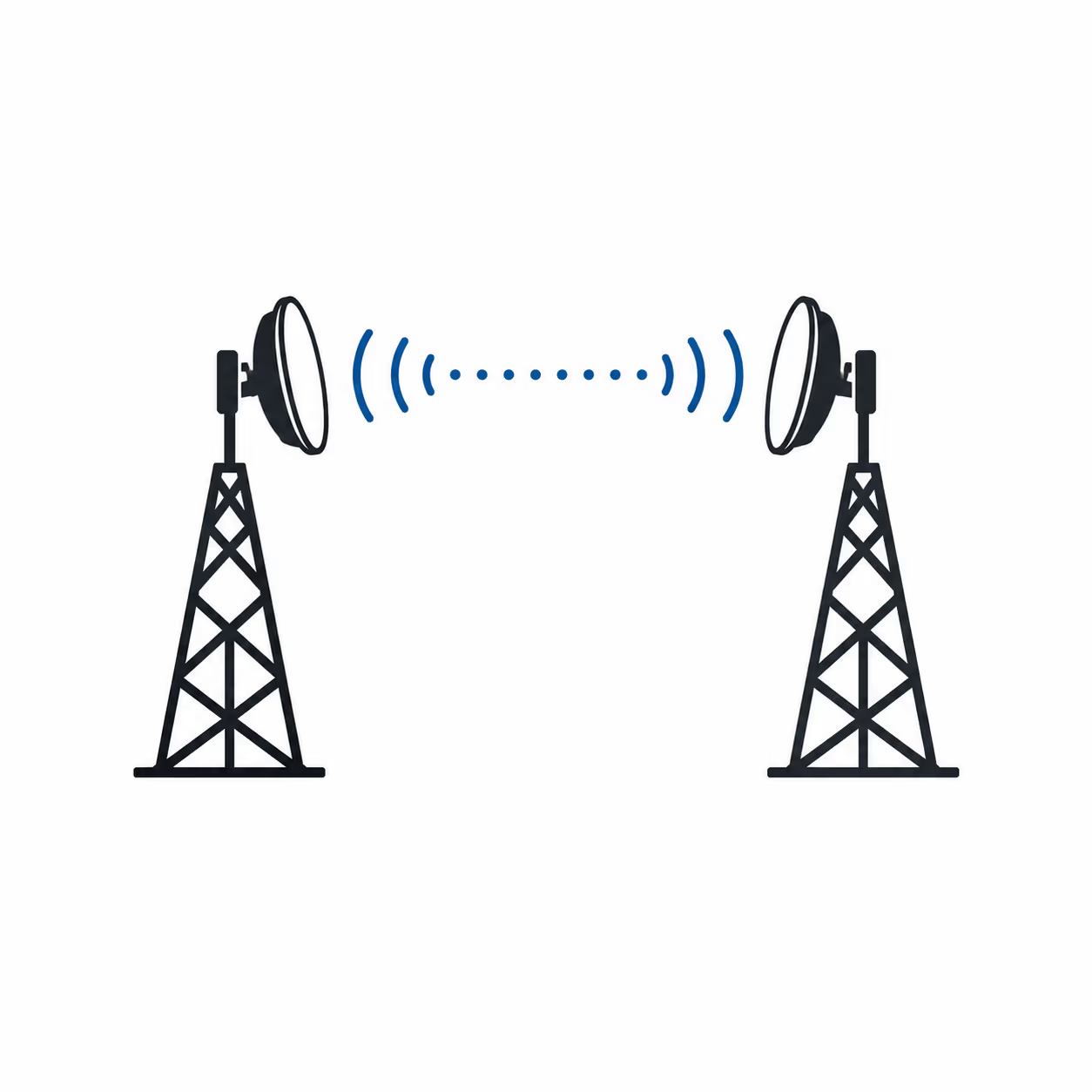
For PTP links, 6 GHz is attractive because it behaves like a natural extension of the traditional 5 GHz WISP toolbox but with more room to breathe. With good line of sight, proper antennas, clean Fresnel clearance, and modern radios, 6 GHz can deliver very high throughput over practical WISP distances. It is especially useful for feeding remote towers, connecting rooftops, extending fiber from a lit building to a nearby site, building redundant paths, or replacing congested 5 GHz backhauls. Modern WISP-style PTP radios can support gigabit-class throughput and long-range links under suitable conditions, depending on environment, antenna design, channel width, noise floor, and regional configuration.
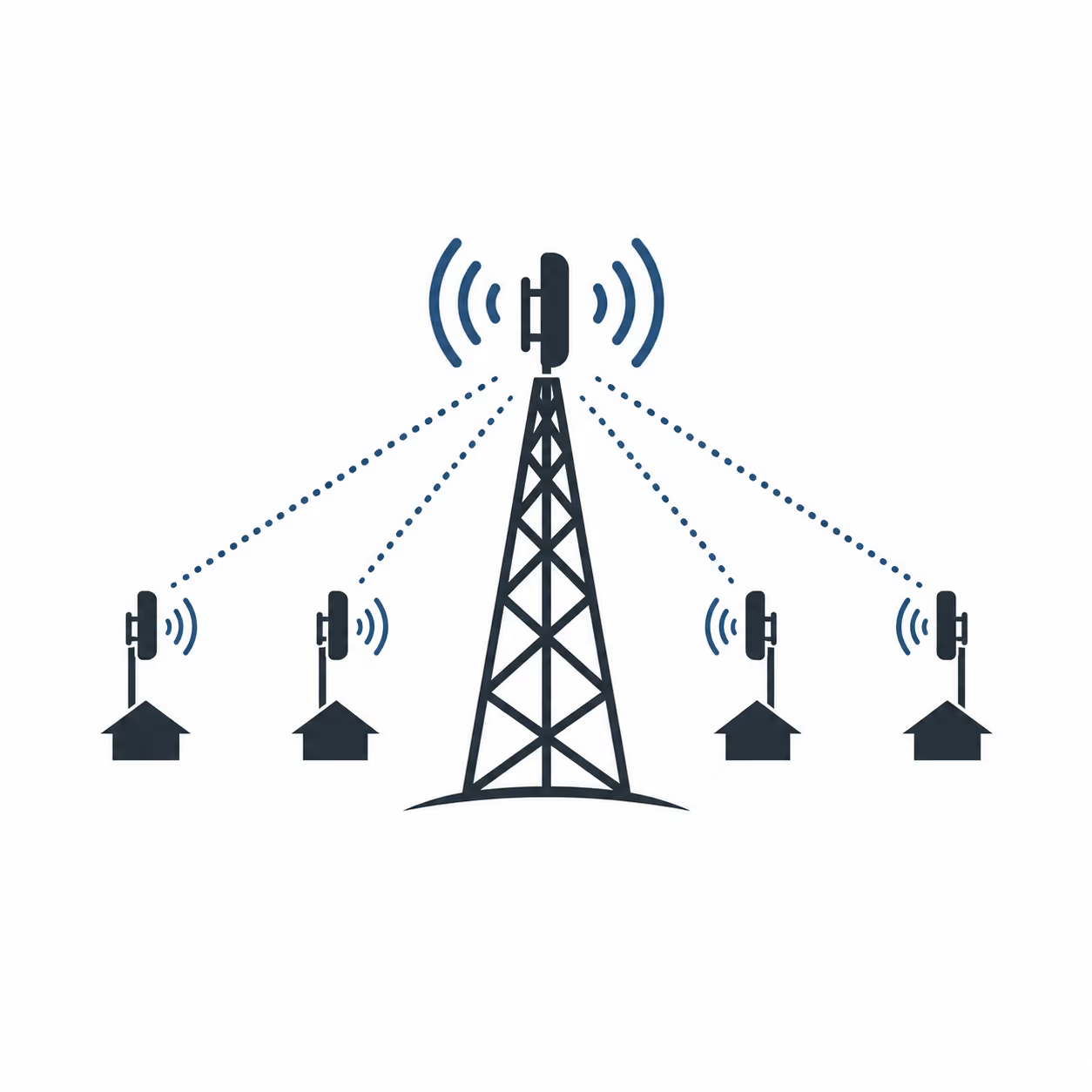
For PtMP, 6 GHz is even more exciting because it gives WISPs a realistic path toward gigabit-class fixed wireless access without jumping straight to millimeter wave. A sector with 80 MHz or 160 MHz of clean spectrum can serve high-ARPU customers, business accounts, MDUs, rural clusters, and dense neighborhoods with far more capacity than legacy 5 GHz sectors. Modern 6 GHz access platforms can combine wide channels, high-order modulation, OFDMA, MU-MIMO, synchronization, and smarter scheduling to create a much stronger fixed wireless access layer.
The WISP value proposition is simple: more MHz means more sellable Mbps. More channel width lets an operator sell larger packages, reduce oversubscription pain, absorb peak-hour usage, and keep latency lower under load. Instead of using 6 GHz only as a Wi-Fi band, a WISP can treat it as a premium fixed wireless layer: 5 GHz for broad coverage and legacy customers, 6 GHz for high-capacity customers and cleaner sectors, and 60 GHz or fiber where ultra-high-capacity short links make sense.
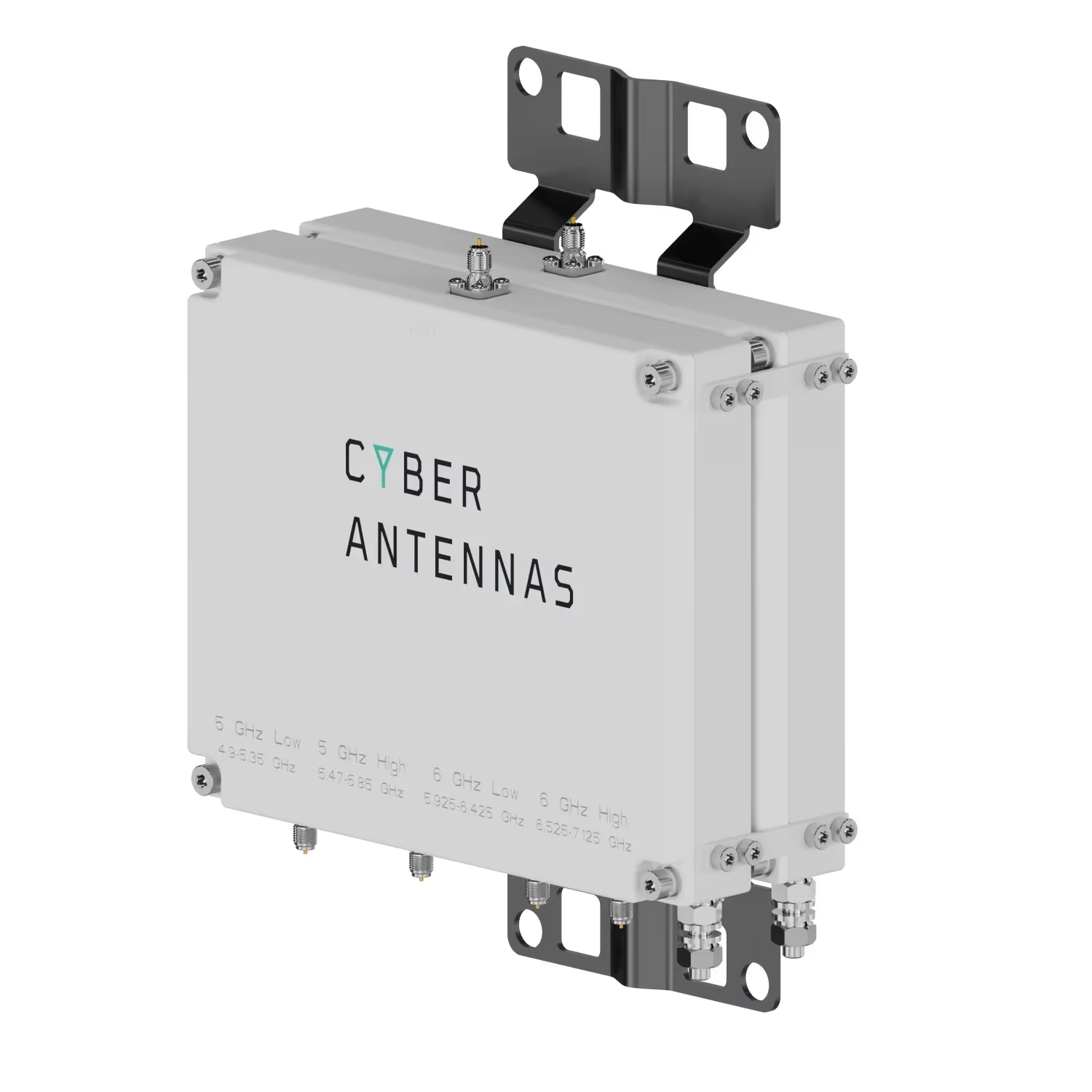
International and wideband radios make the opportunity even bigger. A lot of modern fixed wireless hardware is not designed as a narrow single-country-only platform; many radios are built with broad RF capability and then configured by software, firmware, country profile, or SKU. Some platforms can operate across traditional 5 GHz ranges and extend into 6 GHz, allowing operators to maintain one hardware family while expanding into cleaner spectrum. That gives WISPs more flexibility when planning backhaul, access sectors, customer drops, and network upgrades.
That matters because many WISPs operate in environments where practical spectrum use is more flexible than in heavily managed markets. In those cases, international radios can be extremely useful because they may expose broader frequency ranges, flexible channel widths, high-gain antenna options, adjustable power profiles, and PTP/PTMP modes that let operators engineer around real-world noise instead of being trapped in a few congested channels. The ability to move above standard 5 GHz, use wider channels, and reuse existing tower discipline is a major operational advantage.
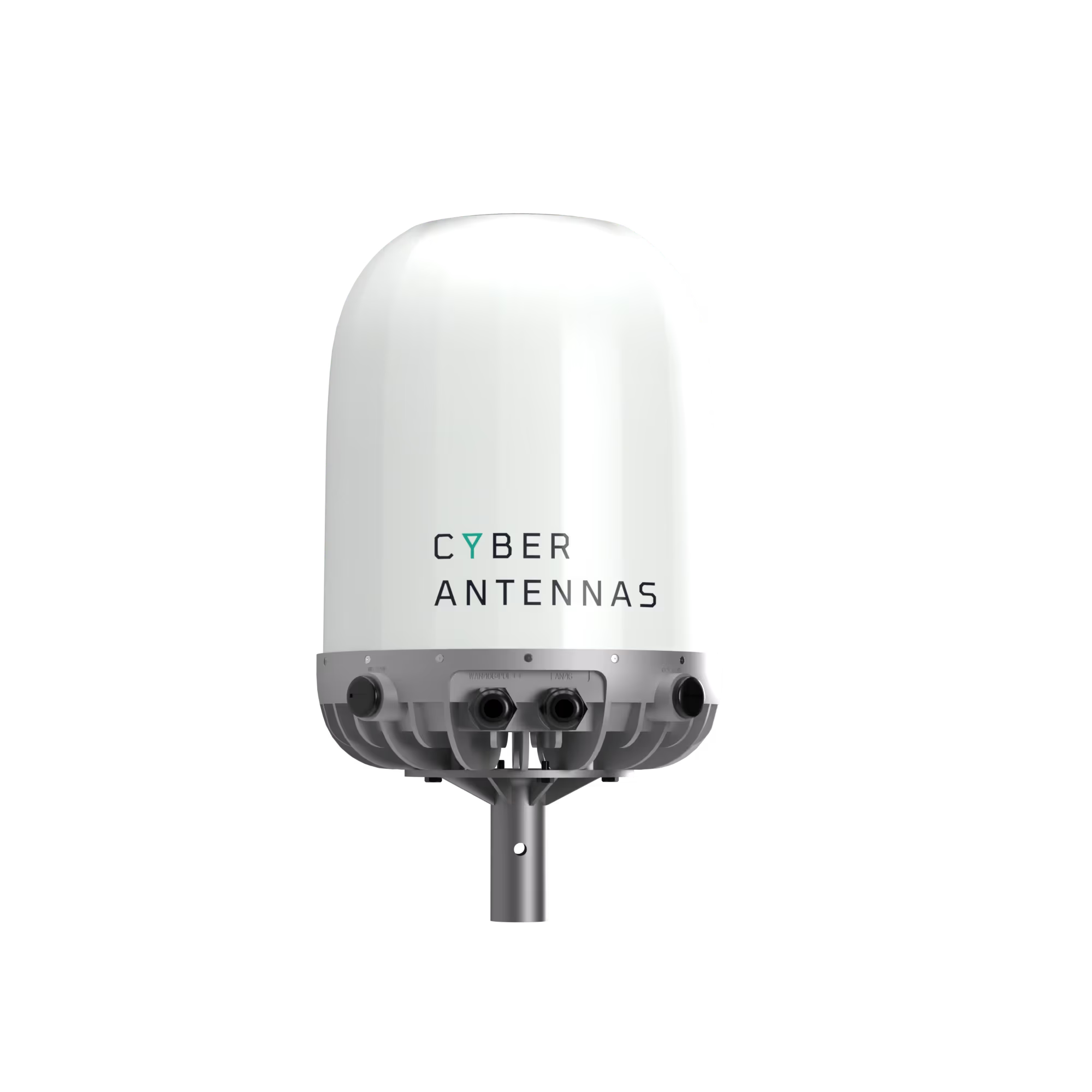
The newer 6 GHz fixed wireless platforms are also much closer to carrier access gear than old Wi-Fi-derived outdoor radios. The important features are not just raw frequency range; they are OFDMA, MU-MIMO, GPS synchronization, beamforming, better scheduler behavior, high-order modulation, wide channels, and improved interference handling. Those features allow a WISP to build cleaner sectors, stack more subscribers, reduce self-interference between towers, and create a more predictable customer experience.
From a deployment standpoint, 6 GHz fits well into the modern WISP network as a premium access and distribution band. A WISP can use it to feed apartment buildings, connect rural subdivisions, light up business parks, serve high-value customers, build wireless fiber extensions, or create high-capacity backhaul between towers that are too expensive or slow to fiber. It is especially strong where the operator already has good tower density, rooftop access, accurate installs, good CPE alignment, and customers within reasonable link distances.
6 GHz also gives WISPs a better upgrade story. Instead of telling customers that fixed wireless tops out at 50, 100, or 200 Mbps, operators can build packages that compete much more directly with cable and fiber in select areas. With the right radio platform, clean spectrum, and proper engineering, 6 GHz can support premium service tiers, gigabit-class business connections, higher-density residential sectors, and stronger MDU offerings.
The real opportunity is not just “Wi-Fi in 6 GHz.” For a WISP, the opportunity is high-capacity outdoor fixed wireless using modern radio systems in a cleaner band. That means more backhaul capacity, denser PtMP sectors, higher customer speeds, better use of tower assets, better service tiers, and a way to extend fiber-like broadband economics into places where trenching fiber is too slow or too expensive.
In plain WISP language: 6 GHz is where you move your serious capacity customers when 5 GHz is tired but fiber is not available yet. It is a high-throughput layer for operators who know how to build clean links, manage sectors, align CPEs, and monetize bandwidth. For PTP, it can replace congested backhauls with gigabit-class wireless paths. For PtMP, it can turn a tower or rooftop into a much higher-revenue asset. For international deployments with broader radio flexibility, it can be one of the most useful bands for scaling fixed wireless broadband without waiting for fiber everywhere.
From an international microwave backhaul perspective, 6 GHz is a strategic long-haul and regional aggregation band rather than a simple access band. It sits low enough in the microwave range to support relatively long paths, good diffraction and clearance tolerance, and high availability, but high enough to provide meaningful channel bandwidth for modern digital fixed links. In many countries, it has historically been one of the most important licensed fixed-service bands for mobile backhaul, broadcast distribution, utility networks, public safety, oil and gas, transport, and long-distance infrastructure links.
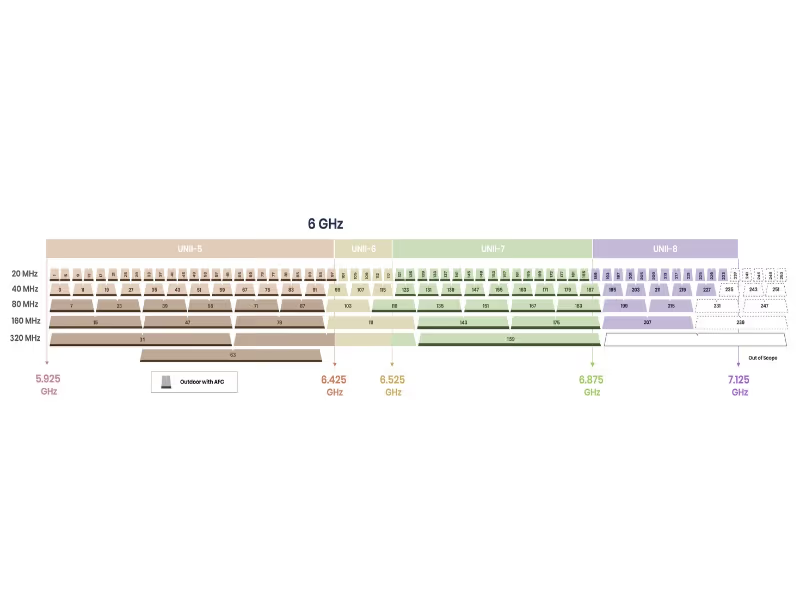
The band is usually discussed in two parts: lower 6 GHz, which is 5925–6425 MHz, and upper 6 GHz, which is 6425–7125 MHz. In practice, operators and regulators often treat these as separate planning domains because they may have different incumbent users, channel plans, licensing rules, duplex spacing, and coexistence constraints.
For microwave backhaul, the main attraction of 6 GHz is reach and reliability. Compared with 11, 13, 15, 18, 23, 38 GHz, or E-band, 6 GHz generally supports longer hops with lower path loss and better resilience to rain fade. This makes it valuable for rural macro backhaul, island networks, mountainous routes, desert routes, utility corridors, and national backbone extensions where fiber is unavailable, uneconomic, insecure, or slow to deploy.
In engineering terms, 6 GHz is often chosen when the design priority is availability over raw spectral efficiency. A 6 GHz hop may not deliver the same per-channel capacity as a wide-channel 18 GHz, 23 GHz, 70/80 GHz, or multi-carrier millimeter-wave link, but it can remain viable across longer distances and harsher propagation environments. This is why 6 GHz remains important in countries with large rural territories, low fiber density, difficult terrain, or high resilience requirements. It is also useful where operators need fewer relay sites. A longer 6 GHz path can sometimes replace multiple shorter higher-frequency hops, reducing tower leasing, civil works, power, security, and maintenance costs.
The band is also important because it supports high-capacity licensed point-to-point infrastructure. High-capacity long-distance radio links are often suitable where optical fiber is not economically realistic. Wider channel arrangements in a contiguous 5925–7125 MHz range can support fiber-like capacity while reducing the number of transceivers, antennas, and tower-space requirements. That point is central internationally: 6 GHz is not merely a legacy band; in many markets it is still a practical substitute for fiber in aggregation and trunking segments.
The downside is that 6 GHz is now one of the most politically contested mid-band ranges in the world. It is attractive not only to fixed-link operators but also to Wi-Fi, 5G/IMT, fixed satellite service, and in some cases broadcast or auxiliary services. For backhaul planners, that means 6 GHz availability is no longer uniform. A link design that is routine in one country may be impossible, transitional, or politically exposed in another.
The United States is a good example of a different regulatory direction. The FCC opened the 6 GHz band for unlicensed use while protecting incumbents, including licensed fixed microwave. For incumbent microwave operators, this does not necessarily mean immediate displacement, but it does mean the band becomes a shared regulatory environment where database accuracy, antenna patterns, link registration, and interference protection become more important.
From an international backhaul planning perspective, the most important regulatory question is whether 6 GHz is protected licensed fixed-service spectrum, shared spectrum, unlicensed-overlay spectrum, or a future mobile/IMT band. The answer varies by country. Some administrations protect 6 GHz fixed links heavily because they are embedded in national telecom, utility, public safety, and broadcast infrastructure. Others are opening all or part of the band for Wi-Fi 6E and Wi-Fi 7. Others are considering or adopting upper 6 GHz for IMT. Some may preserve existing fixed links but restrict new assignments, shorten license terms, require migration, or impose coexistence mechanisms.
Technically, 6 GHz backhaul design follows the same microwave fundamentals but with some band-specific advantages. Link engineers must calculate free-space path loss, terrain clearance, Fresnel-zone clearance, antenna heights, fade margin, rain attenuation, multipath fading, diffraction, interference, polarization discrimination, and availability objectives. At 6 GHz, multipath and ducting can be more important than rain on many long paths, especially over water, flat terrain, deserts, or humid coastal areas. Rain still matters, especially in tropical climates and for very high availability objectives, but 6 GHz is generally much more forgiving than higher microwave and millimeter-wave bands.
A typical international operator would use 6 GHz for macro aggregation, long rural hops, resilient backbone spurs, island-to-mainland links, mountain repeaters, utility SCADA and telecom backbones, and public-safety or mission-critical networks. It is less ideal for dense urban small-cell backhaul where spectrum reuse, rooftop congestion, and shorter high-capacity hops favor 18/23/26/28/38 GHz, E-band, or fiber. In cities, 6 GHz antennas may also be physically larger than higher-frequency antennas for the same gain, which can create tower loading and zoning issues.
A major operational advantage of 6 GHz is that it can support high availability with fewer sites. In many developing or rural markets, tower power, road access, theft, vandalism, and maintenance logistics are the limiting factors, not radio equipment cost. A longer 6 GHz hop can reduce the number of intermediate relay sites, which can materially improve network economics and resilience. This is especially relevant for national mobile operators, wholesale tower companies, government networks, railways, energy companies, and universal-service deployments.
The band’s international value also depends on channel planning discipline. 6 GHz networks require careful high/low site planning, duplex separation, polarization planning, antenna discrimination, and coordination with adjacent links. Coexistence between legacy lower/upper 6 GHz channel arrangements and newer combined-band arrangements is not always simple. Existing channels in 5925–6425 MHz and 6425–7125 MHz may not all coexist with new channels over the same path between the same sites, and transition periods may require compromise. This is a practical warning for operators modernizing legacy 6 GHz networks: refarming the band can increase capacity, but it can also create temporary self-interference and coordination constraints.
In many countries, 6 GHz has also become a strategic spectrum-management issue because fixed microwave links are often invisible to end users but critical to national connectivity. Mobile broadband, Wi-Fi, cloud access, emergency services, power-grid communications, and broadcast contribution links may all depend on 6 GHz fixed links somewhere in the transport chain. Removing or degrading those links without a replacement plan can create hidden network fragility. This is why regulators often require coexistence studies, transition plans, incumbent databases, coordination zones, or grandfathering rules before reallocating 6 GHz spectrum.
From a capacity perspective, 6 GHz can be modernized with wider channels, higher-order modulation, adaptive modulation, XPIC, MIMO-like multi-carrier architectures, and packet-native microwave platforms. However, the actual delivered capacity depends heavily on the national channel plan and licensing policy. A country that permits wider channels and dual-polarized operation can support much more efficient 6 GHz backhaul than a country limited to narrow legacy channels.
International operators must also account for cross-border coordination. A 6 GHz path near a border can affect or be affected by fixed links in a neighboring country. This matters in Europe, Africa, the Middle East, Southeast Asia, and island regions where borders or maritime boundaries are close. Even if a national regulator authorizes a channel, practical deployment may require bilateral or multilateral coordination, especially for high-gain antennas, long paths, and elevated mountain sites.
The arrival of Wi-Fi 6E and Wi-Fi 7 changes the risk profile. In countries that open 6 GHz for license-exempt use, fixed microwave links may remain protected on paper, but operators need stronger administrative discipline. Link records must be accurate, antenna coordinates must be correct, heights and azimuths must be current, and obsolete licenses should be cleaned up. If a database-driven system such as AFC is used, the protection quality depends on the quality of the incumbent data and the assumptions in the propagation and interference model.
The arrival of upper 6 GHz IMT creates a different issue: potential long-term loss of fixed-link spectrum. If a country identifies upper 6 GHz for mobile broadband, incumbent fixed links may face restrictions on new deployments, mandatory migration, compensation frameworks, or coexistence limits. For backhaul planners, this makes regulatory due diligence as important as path engineering.
In developed markets with deep fiber, 6 GHz may gradually shift toward a protected legacy, special-purpose, or resilience band. In developing markets, island states, rural regions, and utility networks, it may remain essential for decades. That divergence is important: global equipment vendors may support 6 GHz, but the business case and regulatory lifetime of new 6 GHz links will differ sharply between countries.
A practical international assessment of 6 GHz backhaul should determine whether the country uses 5925–6425 MHz, 6425–7125 MHz, or both for licensed fixed service. It should confirm whether new fixed-link licenses are still being issued or whether only renewals of incumbents are allowed. It should identify whether lower 6 GHz, upper 6 GHz, or the full 5925–7125 MHz range is open to Wi-Fi or RLAN use. It should also determine whether upper 6 GHz has been identified or reserved for IMT or 5G, whether fixed links are protected by coordination, exclusion zones, AFC, or manual licensing, and whether there are FSS earth stations, broadcast links, military systems, or public-safety incumbents in the same range.
The assessment should also review permitted channel widths, duplex spacing, antenna standards, emission masks, license duration, renewal risk, fee structure, migration policy, and cross-border coordination obligations. Finally, it should determine whether the intended link is temporary capacity, long-term backbone, or critical infrastructure, because the risk tolerance for each case is different.
The strongest case for 6 GHz is long-life, high-availability backhaul where fiber is unavailable or uneconomic and where the regulator continues to protect fixed service. The weakest case is urban or suburban deployment in a country moving aggressively toward Wi-Fi or IMT use of the band, unless the link is grandfathered or has strong incumbent protection.
In summary, 6 GHz remains one of the most valuable microwave backhaul bands internationally because it combines long reach, robust propagation, mature equipment ecosystems, and meaningful capacity. Its future, however, is no longer purely technical. The band now sits at the intersection of fixed microwave, Wi-Fi, IMT/5G, satellite, and national broadband policy. For international backhaul planning, 6 GHz should be treated as a high-value but jurisdiction-sensitive asset: excellent where protected, risky where reallocation is likely, and operationally dependent on disciplined coordination and accurate regulatory data.