IsoHorns
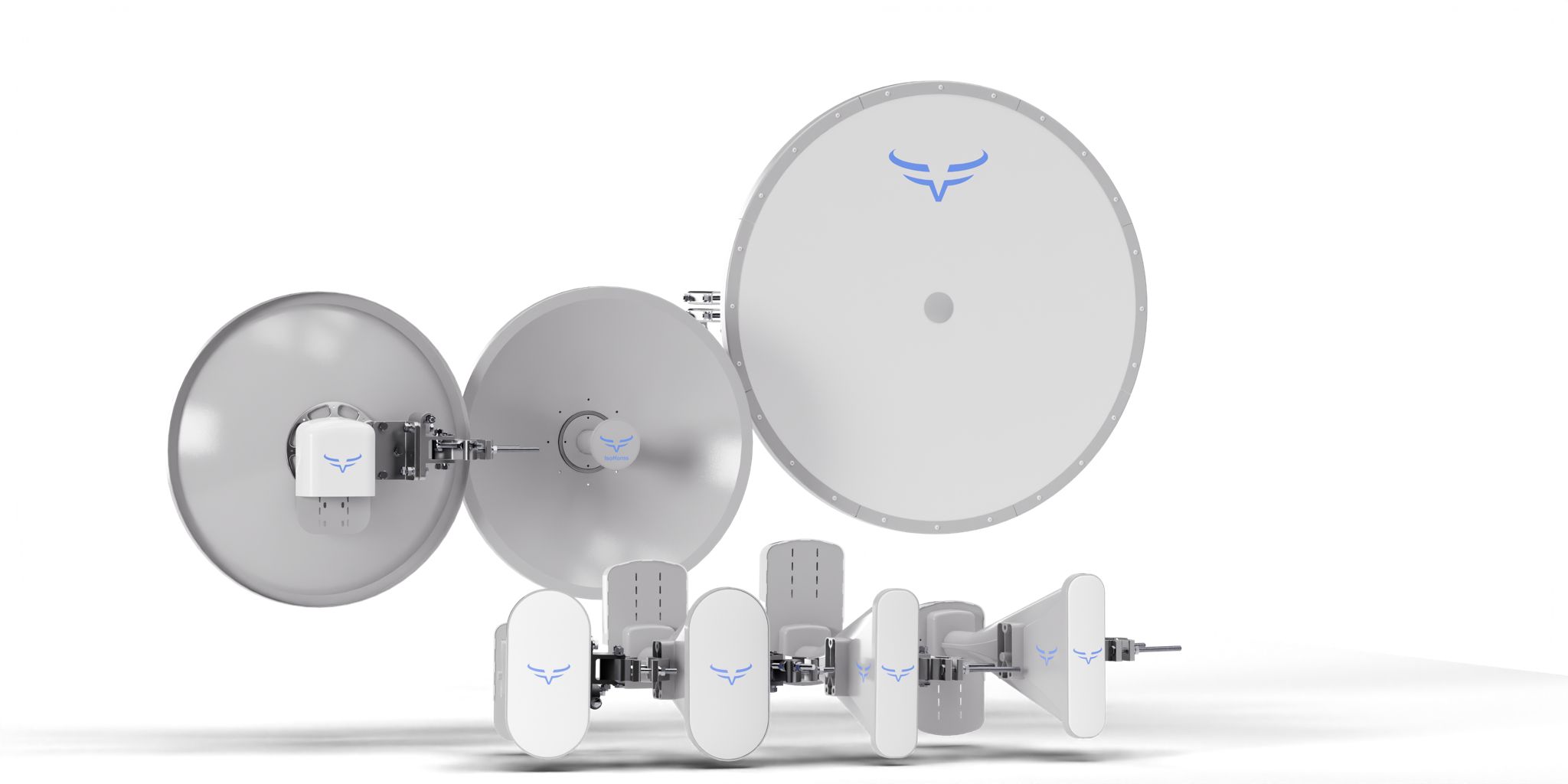

Products by IsoHorns
No products found for this brand.
IsoHorns
0 products
Overview
IsoHorns believes that internet subscribers prioritize fast and reliable Wi-Fi internet service above all else, regardless of whether it's delivered through fixed wireless or fiber-optic connections. Traditionally, Wireless Internet Service Providers (WISPs) have utilized Wi-Fi frequencies, cost-effective radios, and highly directional antennas to engineer connections to locations that would otherwise be impractical or economically challenging to connect using fiber optics or 5G technology. The free market has demonstrated that WISPs are capable of delivering high-quality internet services in a more cost-effective manner, particularly in rural areas, by using Wi-Fi technology.
WISPs can achieve profitability and positive cash flow at any scale by utilizing cost-effective radios operating on Wi-Fi frequencies, which are based on Wi-Fi chipsets. However, to fully harness the advantages of affordable outdoor Wi-Fi radios from manufacturers like Ubiquiti, Cambium, Mimosa, MikroTik, and Ligowave, it's essential for WISPs to employ high-quality directional antennas. These antennas play a critical role in achieving optimal internet speeds and in maximizing the capacity and longevity of their outdoor point-to-multipoint (PTMP) wireless networks.
The sustainable growth of Wireless Internet Service Providers (WISPs) relies on the utilization of high-quality directional antennas, such as those offered by IsoHorns. These antennas empower WISPs to expand their network capacity by implementing spatial division and frequency reuse techniques. Additionally, they boost internet speeds by improving signal-to-noise ratios which leads to higher modulation rates and increased subscriber capacity per access point and tower. Consequently, this also results in reduced subscriber churn, driven by the improved internet speed and reliability experienced by customers.
High-quality antennas make a big difference
- Maximize network capacity by employing spatial division and frequency reuse techniques.
- Achieve faster internet speeds by utilizing high modulation rates
- Increase the number of subscribers per access point by optimizing airtime efficiency and minimizing noise interference.
- Enhance subscriber capacity per tower via spatial division, superior modulation rates, and improved airtime efficiency.
- Minimize subscriber churn by improving overall internet speed and reliability.
Objectively better antennas
Antenna parameters are standardized metrics used across the wireless industry to assess the radio frequency (RF) performance of antennas. IsoHorns antennas consistently exhibit superior performance in these objective measurements. When compared using these standardized metrics, IsoHorns antennas not only measure favorably, but surpass competing products in every measured aspect of performance.
✓ Frequency Range
✓ VSWR
✓ Gain
✓ Front-to-back ratio
✓ Isolation
Future-proof infrastructure investment
Wireless Internet Service Providers (WISPs) will benefit from their investments in wide-band antennas, as these antennas support a broad frequency range from 4.9 to 7.2 GHz. This compatibility allows WISPs to continue using affordable radios while adapting to evolving radio technologies. As radio technology progresses through various stages like Wi-Fi 5 (AC), Wi-Fi 6 (AX), Wi-Fi 6e (AX with 6 GHz), and Wi-Fi 7 (which features multi-link operation using both 5 GHz and 6 GHz channels simultaneously), WISPs can maintain their infrastructure without needing frequent upgrades. This is because high-quality wide-band antennas operating from 4.9 to 7.2 GHz can accommodate these technological advancements.
While fixed wireless competitors gain unfair advantages from market distortions and government favoritism, IsoHorns still believes in the WISP business model. We are committed to maintaining the competitive edge for WISPs by providing high-quality unlicensed 5 and 6 GHz wireless solutions at affordable prices, so WISP businesses can continue to grow profitably.
IsoHorns is built for WISPs and our solutions allow WISPs to maintain profitability while investing in their business and communities. With IsoHorns, WISP installers will be more successful by improving signal levels and modulation rates during site surveys so more new subscribers will meet the minimum signal requirements for installations. IsoHorns asymmetrical sectors extend the distance of your service area by offering higher gain antennas while reducing the noise through spatial division.
By using inexpensive radios combined with highly directional antennas, WISP are uniquely capable of sustainably connecting communities where other providers can't.
✓ WISPs deploy infrastructure quickly
✓ Offer professional installation
✓ Individually engineer fixed connections
✓ Achieve fast return on investment with new subscribers
✓ They provide low latency, high-speed, and reliable internet service
✓ Their focus is on building durable infrastructure with lasting value
IsoHorns is the perfect alternative to RF Elements 5 GHz horn antennas because IsoHorns wideband 6 GHz horn antennas outperform RF Elements narrowband 5 GHz horn antennas in their native 5 GHz frequencies. If you install RF elements narrowband 5 GHz horn antennas today then you will likely need to replace them with 6 GHz horn antennas as the industry shifts to 6 GHz. IsoHorns' wideband horn antennas provide the flexibility for future radio upgrades as technology evolves.
Only IsoHorns antennas outperform other horn antenna manufacturers on both 5 and 6 GHz!
We take pride in being the world’s first manufacturer of premium point-to-multipoint (PTMP) wideband 6 GHz horn antennas covering the entire 4.9 to 7.2 GHz range, including the entire 6 GHz band. Our horn antennas are designed with industry leading best Voltage Standing Wave Ratio (VSWR), a crucial performance indicator measuring the efficiency of power transfer between the antenna and the transmission line. Experience unparalleled radio system performance with our industry-leading 5 & 6 GHz horn antennas.